Monday, October 16, 2017

Reading Notes: Stories from Congo, A

Reading Notes:

This week I read through Stories From Congo and found a few stories that I could retell this week. The stories include How the Wives Restored their Husband to Life, and Another Vanishing Wife.

How the Wives Restored their Husband to Life

In the original story of How the Wives Restored their Husband to Life, three wives each had a gift. The gifts were to dream, to guide, and the bring back to life. When the husband was killed hunting the dreamer dreamed of his death, the guide found a way to his body, and the life giver brought him back to life. I feel as though if I were to retell this story I could switch the husband to a woman and perhaps make the women gifted sisters.  The new addition would have the gift of being a skilled huntress. Instead of choosing a best gift, in my version I could put an emphasis on the importance of each gift and how they worked together.


Another Vanishing Wife

In the original story of Another Vanishing Wife a scrawny young man was tired of being put second to his strong older brother and being mistreated by his family. In response to this he ran away and found a magic canoe that led him to  magical tree in which he pulled a leaf off and it turned into a beautiful woman. The woman changed his appearance and awarded him with wealth and love. The man went against her warning and went to show off to his family. When he did this he lost the wife and his wealth. If I were to retell this story I would put an emphasis on the moral of the story; it is not necessary to impress people who do not care for you. It would be interesting to tell this story from the perspective of the man and to describe how he felt like he had something to prove.

File:Congo, canoe, model in the Vatican Museums-2.jpg
(The Magic Canoe, link)


Bibliography


Notes on the Folklore of the Fjort, Richard Edward Dennett (1898). Link

Thursday, October 12, 2017

Week 8 Progress


Looking Back

Although I am on schedule for an A in the course I have not kept my schedule as much as I would have liked to. I had planned on doing extra credit to get ahead but as my other classes have gotten more difficult I have had trouble finding the time to put in the extra work. I have most enjoyed the reading assignments because I have always enjoyed reading. This is a great opportunity to read things that I may not have been  exposed to otherwise.


Looking Forward

I would like some changes for the second half of the semester. I would really like to keep my schedule better and do more extra credit so I can finish the course a little early.

Image


Related image
(Keep Moving Forward, link)


Week 8 Comments and Feedback

Feedback In

As the semester has progressed I have found that the usefulness of the comments has continually improved. After the first few feedback assignments I think people really started to grasp the importance of the feedback and since I have received some great advice.

Feedback Out

I think that reading other people's work has definitely influenced and improved my personal work. Just as other people's comments have improved the further we get into the course, I think that my comments and feedback has also. I found the assignment on feed-forward very useful and I have tried to use some of the methods for giving useful feedback since then.

Blog Comments

I really have enjoyed both receiving comments and commenting on other people's work throughout this semester. Reading and commenting on the introductions give me a better sense of who people are than I have ever had in any class. It is also really nice to have people make comments on my introduction and say such encouraging and interesting things!

Looking Forward

As I move forward I feel as though I could try to dig a little deeper when reading other's blogs in order to ask questions and give feedback that could be looked over. If I were to change something about my blog it may just be the format of it so it is easier to follow. After looking at my other classmates' blogs I have seen so many that are truly impressive and I would use some of those to inspire mine.


Image

The reason I chose this image is because it can be very intimidating to receive feedback! When I first learned about giving and receiving feedback for this course I was nervous that it could be hurtful and I was afraid of hurting people's feelings. I have found that by using the right methods feedback is not as scary as you'd think. and it can be extremely useful!
(Feedback, link)


Wednesday, October 11, 2017

Week 8 Reading and Writing

Looking Back

To be completely honest, when we began this course I was generally overwhelmed. Being and engineering major I had never been exposed to a class in which we get to choose the topics and then are free to be creative and imaginative on assignments. To say the least I have been pleasantly surprised this far in the semester. 
 
At first I would struggle with each writing assignment since it has been so long since I have done any creative writing, but as the semester continues I am progressively becoming more comfortable with my writing. 

My favorite reading so far has been the section on Ancient Egyptian Myth and Legend. I have always enjoyed Egyptian culture and I found all of the stories to be just as interesting as I had hoped. 
Throughout the semester I have found that the key to a good story is great reading notes on the original. The stories that I have been the most proud of usually stem from using my more detailed reading notes to begin with.

My favorite part of the class so far has been the class project. So far I am really proud of the stories I have chosen and even my website itself. This is the first website I have ever created and even though it is not perfect I am happy with the progress it has made. 

My two biggest writing accomplishments, in my opinion, are both in my portfolio. They are The Man, The Moon and Isis and the Secret Name. I really enjoyed retelling the origin story of how a man became the moon because I had the opportunity to change the meaning of the story entirely. I also received a lot of positive feedback from my classmates about the new meaning so I gained more confidence in my writing. When I rewrote Isis and the Secret name I had the opportunity to change the image of Isis from a villain to a real person with honest emotions and motivations.

Image

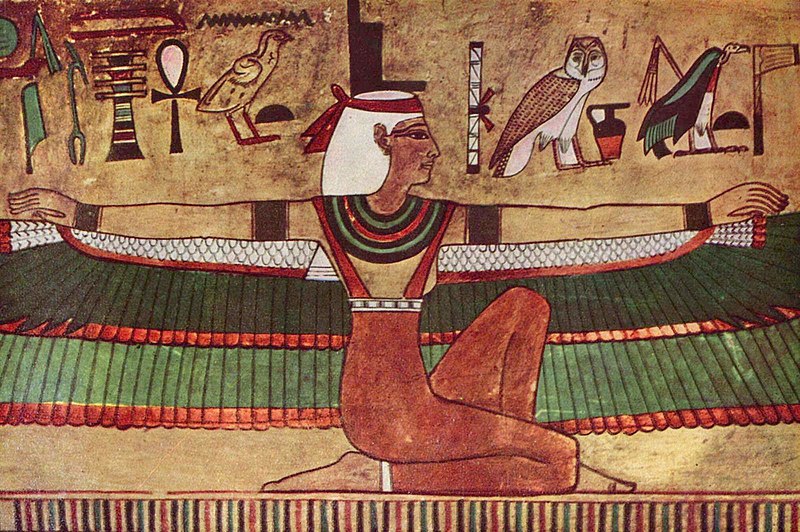
One of my favorite images that I have chosen is of Isis in my story Isis and the Secret Name. I really loved using this image for my portfolio because I was able to design an entire webpage around the colors and themes of the photo. The original photo is a painting on the wall of a tomb that was discovered in Egypt.

File:Ägyptischer Maler um 1360 v. Chr. 001.jpg
(Isis, image from Wikipedia Commons)

Looking Forward

As I look forward I am excited to see how my portfolio turns out. I am very happy with the stories and formatting I have chosen this far and I hope to keep improving the site until it is something I am really proud of. To improve my work I feel as though I should become more creative and adventurous when retelling the stories. So far I have changed perspectives and themes but I have yet to do a major change of setting or characters.


Wednesday, October 4, 2017

Week 7 Story: The Stone-cutter and the Wise Woman

The Stone-Cutter and the Wise Woman

     Once upon a time there was a young boy living in a small village at the base of a large mountain.  The boy was quite imaginative and often requested to hear bedtime stories before he went to sleep; his favorite of which was The Man, The Moon. For years, every evening the boy's mother would retell the story of the blacksmith that had wished many times to be something else until a wise woman finally found the perfect version of him in the moon. Since the boy truly believed in the story he would often spend his days climbing to the stream by the mountain and hoping to find the wise woman that could grant wishes.

 As the years went by the boy became older and his imagination and belief soon diminished. His daily trips to the stream began to grow less and less as the young man was now old enough to become an apprentice to his father, the stone-cutter. The young man turned into a skillful stone-cutter and soon gained the respect of the people of the village for his fine crafting. His father was very proud of his progress and within a year gave the young man the entire shop to work in. Although the young man was well respected and skilled, he was never content with his days work.

One morning the young man was taking a fine piece of marble to a rich man's house and when he arrived he was in awe of the lifestyle that the rich man could afford. The young stone-cutter became bitter that he worked hard every day and still could not afford these luxuries. In his jealously the boy thought back to the story of the blacksmith that was able to simply wish to be something other than what he was and exclaimed, 
"I wish I was a rich man. I would not have to work hard every day and go home to the dainty house my parents call a home!"  
As soon as he exclaimed this a strange young woman approached him and said, "Be careful of your wishes, stone-cutter"  and walked away.
Confused about what the woman had said the young stone-cutter walked home. To his surprise he did not find an old home where his house used to be, but rather a lavish mansion full of the finest art and decorations. 

The stone-cutter was happy for his riches for a while, but soon became lonely. After all, his old friends in the village still spent there days working and did not enjoy spending their free time with the stone-cutter since he would constantly brag about his newfound riches.The loneliness deepened until one day a prince with an entire caravan of servants went through the town. The stone-cutter become jealous of the prince since he seemed to be surrounded by friends. 
Once again, in his jealousy he made a wish. "I wish I was a prince! I would never be alone." 
As soon as he yelled his wish he heard the voice of the young woman, "Be careful of your wishes stone-cutter."

In the blink of an eye the young stone-cutter was in a palace, surrounded by servants. Whenever he tried to speak to his servants they quickly responded and only answered with what they thought the prince wanted to hear. The prince soon realized that the servants were not true friends to him, as they were forced to do whatever he said. The prince became even more bitter, deciding that he was better off to be completely alone. The only problem was that he enjoyed the power of being a prince, and so he went to his gardens to contemplate how he could remain powerful but be alone. While sitting in the garden the sun shone onto his face and made the prince have an idea. "I wish to be the sun! I will be alone in the sky but have all the power of its light." 
The young man had barely noticed the servant girl tending to the garden, and was surprised when it was she that said "Be careful of your wishes. stone-cutter." 

Before the stone-cutter could respond he was transformed into the sun. Of course the stone-cutter was not happy as the sun, and he thought about how easy it was to transform to one thing to another. The stone-cutter  began to wish very recklessly and very  often. Each time the stone-cutter transformed he heard the same warning from the girl and each time he ignored her. Finally, after transforming over a dozen more times without finding happiness the stone-cutter had resigned to be a mountain. At least as the mountain he could see the village he grew up in and remember the good times he had with his family.

One cold day the young man saw a stone-cutter climbing up his rock and chiseling pieces off. The young man thought back to his previous life before the wishes and cried in defeat. It was now that he saw what he had to begin with, and without even thinking about being transformed the man quietly cried; wishing only to have his previous life back. Without a sound the young man was transformed back into a man with a chisel in his hand at the base of the mountain. The young stone-cutter cried in relief to have his original form back and did not notice the woman approaching him. 
The woman put a hand on the man's back  and said "As I said, you must be careful what you wish for. A wish for the wrong motivation will rarely turn out to be what you expect."
The young man apologized for all of the times he did not take her advice, and promised to appreciate his humble life from that day forward.


(The Wise Woman and the Stone-cutter, credit to Paul C at flickr)

Author's Note:

This story was based of the Japanese Fairy-tale of The Stone-cutter. In the original story a stone-cutter had heard of a mountain spirit that had the ability to grant wishes, but did not believe in the spirit until he was transformed. His first transformation to a rich man was not intentional, but after he realized the power they possessed he wished often hoping to find happiness in something else. Finally the stone-cutter had been turned into a mountain and was surprised that the stone-cutter was stronger than the rock that made him. He soon wished to be a stone-cutter once again and stayed a stone-cutter for the rest of his life. In my story I really wanted to relate it to the story that I had already rewritten, The Man, The Moon. I thought that it could be very interesting to tie the two stories together but make the motivations of changing very different. In this story I wanted the stone-cutter to make wished not out of respect for something else, but jealousy and bitterness. Because he was not making wishes for the right reasons, he was ultimately unhappy until he realized the worth of his life before the wishes came true. Ultimately, this story is about realizing what you have when you have it and appreciating yourself for who you are.


Bibliography:

The Crimson Fairy Book, Andrew Lang, illustrated by H.J. Ford (1903)

Reading Notes: Japanese Fairy-Tales B

Reading Notes B

For part B of the Japanese Fairy-Tales unit I found the most interesting story to be the story of Uraschimataro and the Turtle. In this story a talented young fisherman catches a sea turtle and after it begs for release he kindly places the turtle back in the sea. Years later, the fisherman was caught in the storm and almost dies when his boat is sunk but the turtle he once saved saves him. Instead of taking him home the turtle takes him to an underwater kingdom where he meets with a sea princess and stays with her for years without aging. When he decides to visit his parents he finds them dead as 300 years have passed and the years quickly catch up with him and he dies too. If I were to rewrite this story I may make the princess a mermaid since this story vaguely reminds me of The Little Mermaid. Also, I might go into more detail on where the young man originally lived and the changes that had occurred after 300 years. Maybe there would be cars or machines that he does not recognize and this could make him run back to the sea.
File:Hawksbill Sea Turtle Carey de Concha (5840602412).jpg
(Sea Turtle, photo credit to Carey de Concha at Wikipedia commons)

The other story I would consider rewriting is the story of Schippeitaro. In this story a young man is trying to prove that he is brave when he learns about a young woman doomed to be sacrificed to the cat demon of the mountain. When he hears of this he asks a prince to borrow his dog, Schippeitaro, and the dog kills the cat demon. If I were to rewrite the story I may make the dog the boys dog so that he gets to keep him in the end. Also, I may do a gender swap and try to make a young woman try to prove her bravery instead of a young man.


Bibliography

The Crimson Fairy Book, Andrew Lang and illustrated by H.J. Ford (1903.

Tuesday, October 3, 2017

Reading Notes: Japanese Fairy Tales A

Reading Notes


This week I chose to read Japanese Fairy Tales for my reading notes, and found a few that I really enjoyed. The first story that I was surprised to see was the Story of the Stone-Cutter. This story was extraordinarily similar to the first story I read in this course, The Man in the Moon. Although they are both stories about transformation that originated in Asia, the stone-cutter story was very different in the sense that the man ended up as what he was originally. I think it could be really interesting to retell this story since I have already told a similar story with a different end. Perhaps in this story the stone-cutter could have heard the tale of The Man, The Moon and sought out the wise woman to transform him so that he could have a happier life. It would be fun to tell the story in a similar way, but rather than make the stone-cutter end up as something else have the wise woman teach him the lesson of appreciating what you already have.

Colour print of a mountain
(Japanese Mountain, Katsushika Hokusai)

The other story I really enjoyed from this week was the story of The Maiden With the Wooden Helmet. In this story a beautiful young woman is taught the value of work and her mom advises her to wear a wooden helmet to hide her beauty so she is appreciated for her work. When a young man sees the beautiful girl he falls in love and when he finally convinces her to marry him she cannot remove the helmet. The young man does not care and still wishes to marry the beautiful girl, and after the wedding the helmet turns to jewels. I feel like telling this story would be great because it has an important message. If I were to retell the story I may retell it from the young man's perspective and explain how he appreciates her work ethic and does not care what she looks like.


Bibliography

The Crimson Fairy Book by Andrew Lang and illustrated by H. J. Ford (1903).